Resources in this category provide introductory information about response to intervention.
|
|
Essential Components of RTI – A Closer Look at Response to Intervention |
|
The National Center on Response to Intervention (NCRTI) has developed this resource that provides a definition of RTI, reviews essential RTI components, and responds to frequently asked questions.
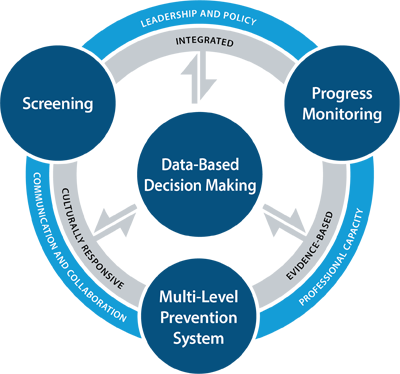
This document lays out four essential components of RTI:
• A school-wide, multi-level instructional and behavioral system for preventing school failure;
• Screening;
• Progress Monitoring; and
• Data-based decision making for instruction, movement within the multi-level system, and disability identification (in accordance with state law).
The information presented is intended to provide educators with guidance for RTI implementation that reflects research and evidence-based practices, and supports the implementation of a comprehensive RTI framework. We hope that this brief is useful to your RTI planning, and we encourage you to
This e-mail address is being protected from spam bots, you need JavaScript enabled to view it
with additional questions you may have regarding effective implementation of RTI.
PDF Version
|
|
|
Implementing Response to Intervention (RTI): Considerations for Practitioners |
|
This brief provides information on the attributes of RTI and discusses the changes that are required in policy and practice if a state or district is going to move toward RTI implementation. Guidance is provided to school leaders who are working to manage the effects of the changes that RTI brings to the different levels of the public school system and the stakeholders involved in the changes.
PDF Version
|
|
|
The ABCs of RTI: A Guide for Parents |
|
This brief from 2007 provides information for parents on what
children may experience in schools that use RTI to identify and
instruct children with specific learning disabilities. It presents a
three-tier model and includes question section that parents could use
to fill in information about screening, progress monitoring, tiered
instruction, staff collaboration, and fidelity of implementation. The
tool was written by Daryl Mellard, Melinda McKnight, and Donald Deshler
and produced by the National Research Center on Learning Disabilities.
PDF Version
|
|
|
Responsiveness to Intervention in the SLD Determination Process |
|
This 2007 brief describes Response to Intervention (RTI) and provides examples of how RTI can work in schools and serve particular students. This resource also addresses the process of identifying specific learning disabilities within an RTI framework. It was produced by the National Research Center on Learning Disabilities and is part of a broader toolkit which can be found here.
PDF Version
|
|
|
Conceptual Confusion within Response-to-Intervention Vernacular: Clarifying Meaningful Differences |
|
This article, released by the National Association of School Psychologists (NASP) in November 2005, focuses on the inconsistencies in the language used in different RTI models, which have the potential to confuse professionals and negatively affect RTI implementation. The article proposes clarifications to the language related to four separate issues: a) RTI problem-solving vs. RTI standard protocol; b) response vs. resistance to intervention; c) response vs. responsiveness to intervention; and d) response to instruction vs. intervention.
Copyright 1993 by the National Association of School Psychologists. Reproduced with permission of the publisher.
PDF Article
|
|
|
SLD Eligibility: A Users’ Guide to the New Regulations |
|
This 2006 brief describes the 2004 amendments to the IDEA, that provide significant changes in the determination of Specific Learning Disability eligibility. It was written by Perry A. Zirkel and released by the National Research Center on Learning Disabilities.
PDF Version
|
|
|
A Research-Based View of Specific Learning Disabilities: Responsiveness to Intervention Overview |
|
This 2007 presentation describes three models of Response to
Intervention (RTI), how RTI fits with IDEA reauthorization, how RTI
operates and tiered instruction. This presentation also provides a
list of questions for stakeholders to consider in thinking about RTI
implementation. It was produced by the National Research Center on
Learning Disabilities. This presentation is part of a broader toolkit
available here.
PDF Version - Presentation | PDF Version - Citations
|
|
|
RTI for Identification of SLD: Early Intervening Services (Part 2) |
|
This 2007 presentation provides an overview of Response to Intervention, its components and uses, including determining specific learning disabilities. It also covers the connection between RTI and Early Intervening Services and implementation lessons from states and districts. It was presented by Daryl Mellard at the OSEP Part B Regulations Regional Implementation Meeting.
PDF Version
|
|
|
Helping Educators Discuss Responsiveness to Intervention with Parents and Students |
|
This 2007 fact sheet provides answers to frequently asked questions
regarding RTI and addresses such topics as learning disabilities
identification, conceptualization of RTI, steps for a model of tiered
intervention, challenges to consider in implementation, assessment
using RTI, and the role of parents. It was written by Lynn Fuchs and
Daryl Mellard and produced by the National Center on Learning
Disabilities. This resource would be of use for administrators and
teachers who are looking for responses to commonly asked questions
regarding RTI and RTI implementation in their schools. The resource is
part of a broader toolkit produced by NRCLD and is available here.
PDF Version
|
| |
|
|
<< Start < Prev 1 2 3 4 5 Next > End >>
|
| Results 1 - 10 of 42 |